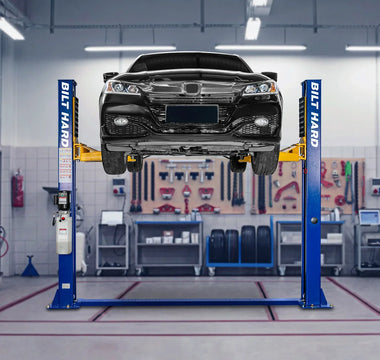
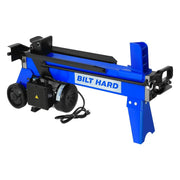
A 12-foot usable ceiling is the safest planning target for most full-rise two-post car lifts, while a portable or low-rise lift can work in many garages with 8 to 9 feet of clearance. The exact requirement depends on the lift’s installed dimensions, your desired working height, the tallest vehicle you will raise, and the lowest object above the bay.
Begin with accurate measurements of the ceiling, garage door hardware, floor space, and vehicle. A lift that fits between the floor and ceiling can still place a raised vehicle too close to a door track, opener, light, or structural beam.
How High Should a Ceiling Be for a Car Lift?
For a full-rise service lift, 12 feet is a useful planning target rather than a universal minimum. Some floor-plate two-post lifts have columns under 10 feet tall, yet the vehicle may reach the ceiling before the lift reaches its highest lock.
|
Usable ceiling height |
Lift types to consider |
Expected access |
Main fit check |
|
8-9 feet |
Portable or low-rise lift |
Seated or creeper-level work |
Raised roof versus the lowest obstruction |
|
10-11 feet |
Portable, mid-rise, or compatible floor-plate two-post lift |
Partial or full rise, depending on the vehicle |
Column height and raised vehicle envelope |
|
12 feet or more |
Many full-rise two-post and four-post models |
Better chance of walk-under access |
Exact lift, vehicle, door, and slab specifications |
Two separate calculations matter. First, the installed lift structure must fit below every fixed obstruction. Second, the raised vehicle must remain clear of the ceiling, open garage door, tracks, opener, lights, pipes, and storage.
For a frame-contact lift, estimate the raised roof position by adding the lifting point’s height above the floor at the intended mechanical lock to the vertical distance from that lifting point to the vehicle’s highest point. Then add the overhead clearance required by the lift manufacturer. Add the clearance required by the lift manufacturer. A four-post storage setup needs a different stack calculation that includes both vehicles, the runway position, and the required separation.
Do not assume that a published maximum rise will be usable in your garage. The highest safe lock may be lower. Your goal also matters because brake work may need far less rise than standing under the center of the vehicle.
What Should Be Measured Before Choosing a Lift
Measure the whole operating envelope instead of taking one floor-to-ceiling number. Record the proposed column locations, the center of the vehicle, and the path of its roof as the lift rises.
Measure to the Lowest Ceiling Obstruction
Measure vertically from the floor to the bottom of the lowest object inside the lift area. Take readings at the front, center, rear, and column positions because floors and ceilings may vary.
Use the smallest measurement as your usable ceiling height. For a sloped or vaulted ceiling, draw the lift footprint on the floor and measure above each critical point. The high center of the ceiling does not help if a column or raised roof enters a lower section.

Check Garage Door Tracks and Openers
Open the garage door fully before measuring. The door panels, horizontal tracks, torsion hardware, and center-mounted opener rail may sit well below the ceiling. Also, watch the moving path of the door, since a vehicle that clears the closed door may interfere when the door opens.
A high-lift door conversion or wall-mounted opener can recover space in some garages. Have a qualified garage-door professional confirm that the door, springs, tracks, and opener remain compatible. Re-measure after the door layout changes.
Leave Room Above the Raised Vehicle
Plan clearance above the tallest configured vehicle, including antennas, roof racks, cargo boxes, and lift kits. Use the required clearance in the lift manual. If the manual does not state an overhead value, obtain written guidance from the manufacturer or installer instead of adopting a generic number from another brand.
Mark the calculated roof height on a wall or column. During initial operation, stop at a lower mechanical lock and verify clearance from several angles. Raise only after the vehicle is stable and every overhead hazard remains clear.
What Needs to Be Checked More Than Ceiling Height
A suitable ceiling only answers one part of the installation question. The floor, bay width, electrical supply, lift-point reach, vehicle weight, and local requirements can rule out a model that appears to fit overhead.
Make Sure the Concrete Slab Can Support It
Use the exact manual’s required slab thickness, compressive strength, reinforcement, anchor spacing, edge distance, and concrete condition. There is no safe universal slab number for every car lift. A two-post lift places concentrated forces at two anchored columns, so a slab that supports parked vehicles may still fail the lift manufacturer’s requirements.
Do not anchor into cracked, deteriorated, unknown, or unsuitable concrete. If you lack original slab records, ask a qualified structural professional or installer how to verify it before drilling.
Check Garage Width and Column Clearance
Compare the lift’s overall width and drive-through clearance with the actual bay. Then allow room for arm movement, vehicle mirrors, open doors, the power unit, controls, wall storage, and a clear walking path. Mark the full footprint with tape and park the widest vehicle inside it.
Column placement must also let every arm reach an approved lifting point without forcing the vehicle against a wall. Keep enough approach distance to center the vehicle as directed in the manual. A wide two-car garage can become a tight single working bay once posts and tool access are included.
Check Power Requirements Before Installation
Power varies by model. Confirm voltage, phase, frequency, motor rating, circuit protection, disconnect requirements, and cord or hard-wiring instructions before installation. Have a qualified electrician complete fixed wiring and confirm compliance with local electrical rules.
Your Vehicle Height Matters Too
Measure the tallest vehicle in the condition in which it will enter the bay. Include roof accessories and future vehicles you realistically expect to service. For a frame-engaging lift, measure from the manufacturer-approved contact point to the highest point of the vehicle because that vertical distance rises with the lift pads.
Capacity alone does not prove compatibility. Confirm actual vehicle weight, weight distribution, center of gravity, arm reach, adapter requirements, and approved lift points.

What Lift Works With Your Ceiling Height?
The following matches focus on usable ceiling height, but each model still requires a separate check of the vehicle, slab, power supply, bay width, and installation manual.
Car Lifts for 8- to 9-Foot Ceilings
Traditional two-post lifts often lose useful rise in an 8- to 9-foot garage because their columns and the raised vehicle compete for the same limited space. The BILT HARD 6,000 lb Portable Car Lift avoids tall fixed columns. Its frames are 4.48 inches high when lowered, and the system raises to 25.4 inches while supporting vehicles up to 6,000 lbs. It suits oil changes, brake service, and undercarriage inspections when seated or creeper-level access is acceptable.
Car Lifts for 10- to 11-Foot Ceilings
A 10- to 11-foot garage may accept a floor-plate two-post lift, although the available rise will depend on the vehicle. The BILT HARD 11,000 lb Two-Post Car Lift has an overall height of 109.4 inches, an overall width of 137.2 inches, and a maximum lifting height of 71.7 inches. It's a 220V, 60Hz, single-phase 3 HP power unit that supports an 11,000 lb rated capacity.
Those dimensions let the columns fit below a flat 10-foot ceiling with about 10.6 inches left above them. That figure does not guarantee full lift travel. Calculate the raised roof position for your car, SUV, or light truck, and check the open garage door before choosing a usable top lock.
Car Lifts for 12-Foot and Taller Ceilings
With 12 feet or more of usable height, taller vehicles and higher working positions become easier to accommodate. The BILT HARD 12,000 lb Two-Post Car Lift supports up to 12,000 lbs, lifts from 3.9 to 71.7 inches, and stands 112.6 inches tall. Its hydraulic power unit requires 220V, 60Hz, single-phase power and uses a 4 HP motor.
The added ceiling space gives a tall SUV or pickup more room above the lift point, yet the same calculation still applies. Confirm the vehicle’s actual weight and roof height, then verify arm reach and lift points. Full-rated capacity should never replace a vehicle-specific compatibility check.
FAQ
Can You Put a Car Lift Under a Sloped Ceiling?
Yes, if the lift structure and raised vehicle stay below the lowest obstruction across the full operating envelope. Measure above every column and roof position. Use the smallest clearance, then confirm the layout with the manufacturer or installer.
Does a Car Lift Need to Be Bolted Down?
It depends on the design. Anchored two-post lifts must follow their manuals and approved concrete requirements. Some portable lifts are designed without permanent columns. Never omit anchors or add them unless the manufacturer’s instructions call for that setup.
Do You Need a Permit to Install a Car Lift?
Possibly. Building, structural, electrical, fire, and zoning rules vary by location and project scope. Ask your local building department before ordering. Provide the model manual, electrical data, anchor plan, and any garage-door or structural changes.
Can You Install a Car Lift in a Home Garage?
Yes, when the garage meets the lift manufacturer’s requirements for clearance, concrete, power, and layout. Confirm local approval, use approved vehicle lifting points, and follow the installation and operating manuals before anyone works under the vehicle.
Conclusion
For most full-rise service lifts, plan around a 12-foot usable ceiling. Choose a portable or low-rise design when the garage offers only 8 to 9 feet, and treat 10 to 11 feet as a model-and-vehicle-specific range rather than an automatic full-rise fit.
Measure to the lowest obstruction with the door open, calculate the raised roof position, and verify the slab, width, power, and lifting points. The right answer comes from matching one lift, one garage, and the tallest vehicle you expect to raise.