You start what looks like a simple, straight-line trench.
A few hours later, your back is aching, the depth is inconsistent, and you’re already behind schedule.
Renting a skid-steer trencher feels like overkill.
Manual digging is killing your productivity—and your profit margin.
If that sounds familiar, you’re not alone.
And yes—there is a better way.
What You’ll Learn in the Next 3 Minutes
By the time you finish this guide, you’ll know:
-
Whether a walk-behind trencher actually fits your type of work
-
How to choose the right machine without overspending
-
Where this tool delivers real value—and where it doesn’t
No fluff. No sales hype.
Just straight answers for people who trench for a living.
1. Who Should (and Shouldn’t) Use a Walk-Behind Trencher
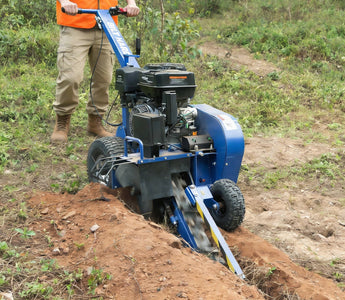
A walk-behind trenching machine lives in the sweet spot between hand tools and heavy equipment.
It’s not for everyone—which is exactly why it works so well for the right users.
✅ The Perfect Fit: 3 Types of Pros
1) Landscaping & Irrigation Contractors
If you regularly install drainage systems, irrigation lines, or planting beds—especially in tight or finished spaces—this is a serious upgrade from shovels or chainsaw trenchers.
You get cleaner cuts, consistent depth, and far more control than a bulky mini skid-steer or full ditch witch trencher.
2) Small Utility & Trade Contractors
(Electrical · Plumbing · Fiber · Low-Voltage)
Running conduit, pipe, or cable rarely justifies a full-sized trencher. A walk-behind trencher gives you speed and precision without rental logistics, oversized trailers, or wide-access job sites.
It’s often the most practical small trencher for residential and light commercial work.
3) Farmers & Property Managers
From field irrigation to drainage fixes, trenching needs to be fast, repeatable, and low-impact.
A walk-behind trencher handles long runs efficiently while minimizing surface disruption—especially important when timing and land preservation matter.
❌ Think Twice If You’re In One of These Groups
One-Time DIY Users
Only digging a single shallow trench for lighting or a garden hose? Renting or hand tools make more sense.
Heavy Civil or Deep-Excavation Crews
If you need trenches deeper than 4–5 feet, are cutting through solid rock, or moving serious earth, a skid-steer or excavator is the right tool—not this one.
2. How to Choose the Right Machine
(Ignore the Spec Sheet—Focus on These 3 Things)
Horsepower numbers and feature lists look impressive, but in real-world trenching, only three factors actually matter.
① Trench Size (Depth & Width)
This determines what jobs you can realistically take on.
-
Depth: Around 24 inches covers most irrigation, drainage, and utility lines
-
Width: 3–4 inches is ideal for conduit, pipes, and bundled cables
Anything more is usually unnecessary—and harder to manage.
② Power vs. Control
Raw power means nothing if the machine is hard to steer.
Look for a balance:
Enough torque to handle compacted soil and small roots, paired with smooth engagement and stable tracking. That’s what keeps trenches straight and operators fresh.
③ Access & Transport
If you can’t get the machine to the job site, it’s useless.
Prioritize:
-
Narrow overall width (gate-friendly)
-
Manageable weight
-
Ability to handle uneven terrain without tearing up finished surfaces
This is where walk-behind trenchers often outperform mini skid steer ditch witch setups.
Quick Comparison Guide
| Tool Type | Best For | Main Limitation |
|---|---|---|
| Chainsaw / GeoRipper trencher | Short, shallow runs | Fatigue, limited depth |
| Walk-Behind Trencher | Most irrigation, drainage & utility work | Not for deep excavation |
| Skid-Steer Trencher | Large-scale commercial projects | Cost, access & transport |
3. Where It Works Best: Real-World Use Cases
🏡 Landscaping & Drainage
Task: French drains, yard drainage systems
Why it works: Consistent depth and clean trench walls ensure proper water flow and long-term performance.
🚜 Agriculture & Irrigation
Task: Running water lines across fields or pastures
Why it works: Narrow trenches reduce surface damage. Speed matters when weather windows are tight.
🔌 Electrical & Communications
Task: Low-voltage lighting, fiber optic lines, conduit runs
Why it works: Precision digging helps avoid existing utilities and costly rework.
🏢 Property & Facility Maintenance
Task: Drainage repairs, utility prep, infrastructure updates
Why it works: Faster completion, less restoration, and cleaner inspections.
🚧 Municipal & Public Works (Light Duty)
Task: Sidewalk edging, roadside drainage, minor utility repairs
Why it works: Enough power for the job—without the disruption and cost of heavy equipment.
4. Your Next Step: The 10-Minute Trench Test
Before buying anything, ask yourself three questions based on your last few trenching jobs:
-
Time: Did manual digging or equipment slow you down?
-
Quality: Were depth and width consistent—or did you need rework?
-
Access: Was getting equipment on-site a headache?
If you answered “yes” to access problems
or “no” to time and quality—
A walk-behind trencher isn’t just an option.
It’s an upgrade to how your business operates.
Final Thought
You don’t need the biggest machine on the market.
You need the right machine for the work you actually do.
If trenching is slowing you down, wearing out your crew, or eating into profit, it may be time to change how you dig—not just how hard.