Keep large spaces cooler and better ventilated with BILT HARD industrial drum fans, designed for workshops, garages, warehouses, barns, and job sites where everyday fans fall short. Our heavy-duty drum fans deliver high-velocity airflow to help circulate stale air, reduce heat buildup, and create a more comfortable working environment. With durable metal construction, portable designs, and multiple size and speed options, you can choose the right one for everything from focused shop cooling to broad-area air movement.
Yes. A drum fan is energy-efficient because it moves air without using a refrigeration compressor. For lower operating costs, choose a brushless DC motor, variable-speed control, and high CFM-per-watt performance.
BILT HARD drum fans include high-airflow options with multiple speed settings, while selected models use DC motors and variable-speed control to improve airflow efficiency and give users more control over power consumption.
Some drum fans are relatively quiet at low speed, but high-velocity models are usually louder as airflow increases. Noise depends on the motor, blade design, fan size, speed setting, and surrounding surfaces.
Or consider pedestal fans for smaller spaces where quiet and portability may be more important than maximum airflow
A drum fan is better for large, hot, or poorly ventilated spaces, while a regular fan is better for bedrooms, offices, and personal cooling.
Drum fan: Powerful airflow, durable metal construction, suitable for garages, workshops, and warehouses for ventilation and drying.
Regular fan: Quieter, lighter, less expensive, and suitable for everyday indoor comfort.
A 24-inch variable-speed drum fan is the best choice for most garages, workshops, and commercial spaces because it balances strong airflow, lower noise, and portability.
The BILT HARD 24-inch Ultra Quiet Variable Speed Drum Fan is a top choice with a brushless DC motor, adjustable airflow up to 7,800 CFM, low-speed operation around 50 dB, wheels, handles, and an adjustable tilt for easy positioning.



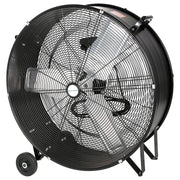




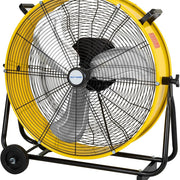

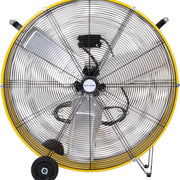


 BILT HARD 30" 13000 CFM High Velocity Drum Fan: 2-Speed Heavy Duty Industrial Fan, UL Listed$249.99
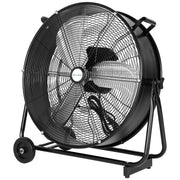
 BILT HARD 34" 15000 CFM Industrial Drum Fan, 3-Speed Heavy Duty Shop Fan – UL Listed$319.99
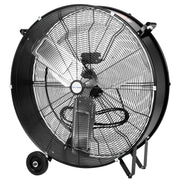
 BILT HARD 30" 13000 CFM High Velocity Drum Fan: 2-Speed Heavy Duty Industrial Fan, UL Listed (Yellow)$229.99