BILT HARD wall fans provide powerful airflow, space-saving installation, and reliable cooling for garages, workshops, warehouses, patios, gyms, and other large spaces. Designed as an efficient solution, these fans deliver high-velocity air circulation with adjustable speeds and durable construction while keeping floors clear and work areas organized. Whether you need targeted cooling for a workstation or improved ventilation across a larger area, BILT HARD wall mount fansoffer the performance and flexibility needed for residential, commercial, and industrial applications.
Yes. A wall-mounted fan can reduce AC costs when its airflow lets you raise the thermostat or run the air conditioner for fewer hours. However, a fan cools people through air movement rather than lowering the room temperature, so turn it off when the area is empty.
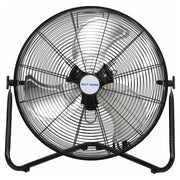
For larger spaces that require stronger air circulation, users can also consider a drum fan designed for garages, workshops, and commercial environments.
No. A typical residential wall fan uses about 35–100 watts, depending on its blade size, motor, and speed setting. Large industrial models may use more power, but they generally consume much less electricity than air conditioners.
BILT HARD wall fans provide high-velocity airflow with multiple speed settings, helping circulate air efficiently without relying on energy-intensive cooling systems. They are practical for garages, workshops, patios, warehouses, and other spaces where continuous airflow is needed.
A wall mount fan is better for targeted airflow and rooms with impractical ceiling installation. A ceiling fan is usually better for circulating air throughout an entire room.
Wall-mounted fan: Saves floor space, directs air toward specific areas, and is easier to position near workstations. Best for garages, workshops, warehouses, gyms, patios, and rooms with low or unsuitable ceilings.
Ceiling fan: Distributes air more evenly across a large room and operates without using wall or floor space. Best for bedrooms, living rooms, dining areas and other spaces requiring whole-room circulation.
A good wall fan provides strong airflow, stable mounting, and suitable coverage without excessive noise. BILT HARD wall mount fans are designed for high-velocity air circulation while keeping the floor clear, making them suitable for garages, workshops, barns, patios, and commercial spaces.
An 18–20-inch wall-mounted fan is the most practical choice. Choose the size of wall-mounted fans according to the area, required airflow, and mounting space:
14–16 inches: Small rooms, individual workstations, and compact covered patios.
18–20 inches: Garages, workshops, home gyms, and medium-sized commercial areas.
24 inches: Large shops, barns, patios, and warehouse work zones.
30 inches: Large industrial spaces, loading docks, and areas requiring wide, high-volume airflow.
Blade size alone does not determine performance. Compare the CFM rating, airflow direction, and oscillation range before choosing.



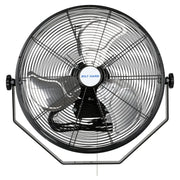




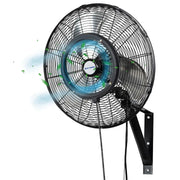

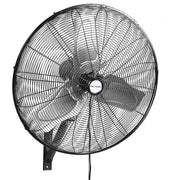

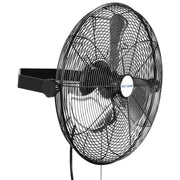

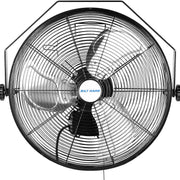


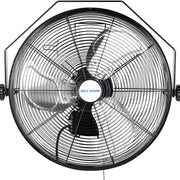


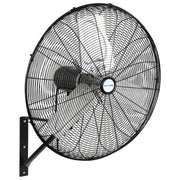

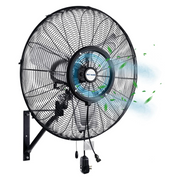


 BILT HARD 20" Outdoor Wall Misting Fan: 3-Speed, 80° Oscillation, Waterproof, Heavy-Duty & UL Listed$189.99
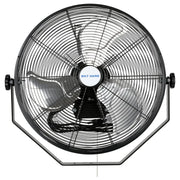
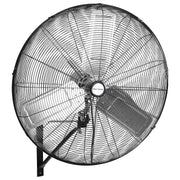
 BILT HARD 30" 9500 CFM High-Velocity Wall Fan: 3-Speed Oscillating Industrial Fan, Heavy-Duty & UL Listed$299.99